Good evening.
Pick a problem. Get the steps to fix it.
Step-by-step guides with 7-day plans for overthinking, focus, discipline and 13 more problems. Plus ideas from books like Atomic Habits, and the classics in plain English. Read or listen in five minutes.
Free to start. No account needed.
What are you stuck on?
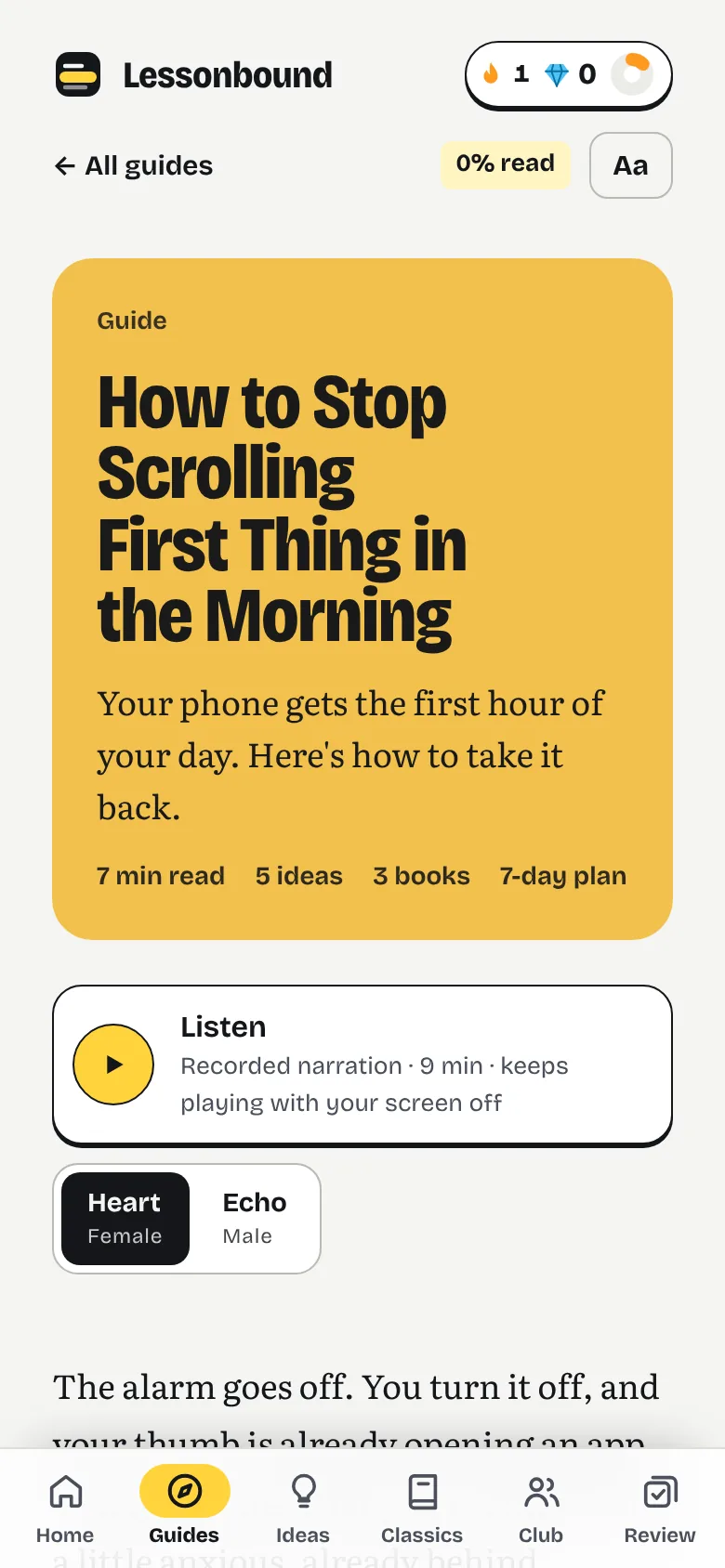
Pick a problem. Each guide gives you a step-by-step routine, the book ideas behind it, and a 7-day plan. Stop Scrolling First Thing in the Morning is free.
- FreeStop Scrolling First Thing in the MorningYour phone gets the first hour of your day. Here's how to take it back.7-day plan
- Earn Back Your FocusYou can't read a page without checking your phone. Here's how to rebuild your attention.7-day plan
- Get Your Energy BackYou sleep eight hours and still wake up tired. Here's where your energy is going.7-day plan
- Build Discipline That LastsMonday: new diet, new gym plan, 5am alarm. Thursday: it's over. Here's what lasts.7-day plan
- Start the Task You Keep Putting OffIt's been on your list for weeks. Here's how to start it today.7-day plan
- Stay Calm When Someone Disrespects YouSomeone talks down to you, and you replay it for days. Here's how to keep your head.7-day plan
- Talk to Strangers Without FreezingYou want to start conversations, but your mind goes blank. Here's how to make it easier.7-day plan
- Stop Spending Money to Impress PeopleYou earn decent money and still feel broke. Here's where the image tax is going.7-day plan
- Stop Caring What People ThinkYou keep editing your life for an audience that isn't watching. Here's how to stop.7-day plan
- Stop OverthinkingYou replay conversations and run every worst case. Here's how to get out of your head.7-day plan
- Break a Bad HabitYou've quit before and it came back. Here's how to make it stay gone.7-day plan
- Read More Books (and Remember Them)You buy books faster than you finish them. Here's how to read more and keep what you read.7-day plan
- Say No Without Feeling GuiltyYou say yes, then spend the week resenting it. Here's how to say no and keep the friendship.7-day plan
- Stop Comparing Yourself to OthersSomeone is always ahead of you online. Here's how to stop measuring your life against theirs.7-day plan
- Be Alone Without Feeling LonelyA quiet evening feels like proof that something's wrong. Here's how to enjoy your own company and build real connection.7-day plan
- Get Back on Track After Falling OffOne bad week turned into a bad month. Here's how to restart without waiting for Monday.7-day plan
One idea. One scene. One thing to try.
46 ideas from books like Atomic Habits, Deep Work and Meditations. Each one plays out the same moment twice, once without the idea and once with it, then gives you one thing to try today.
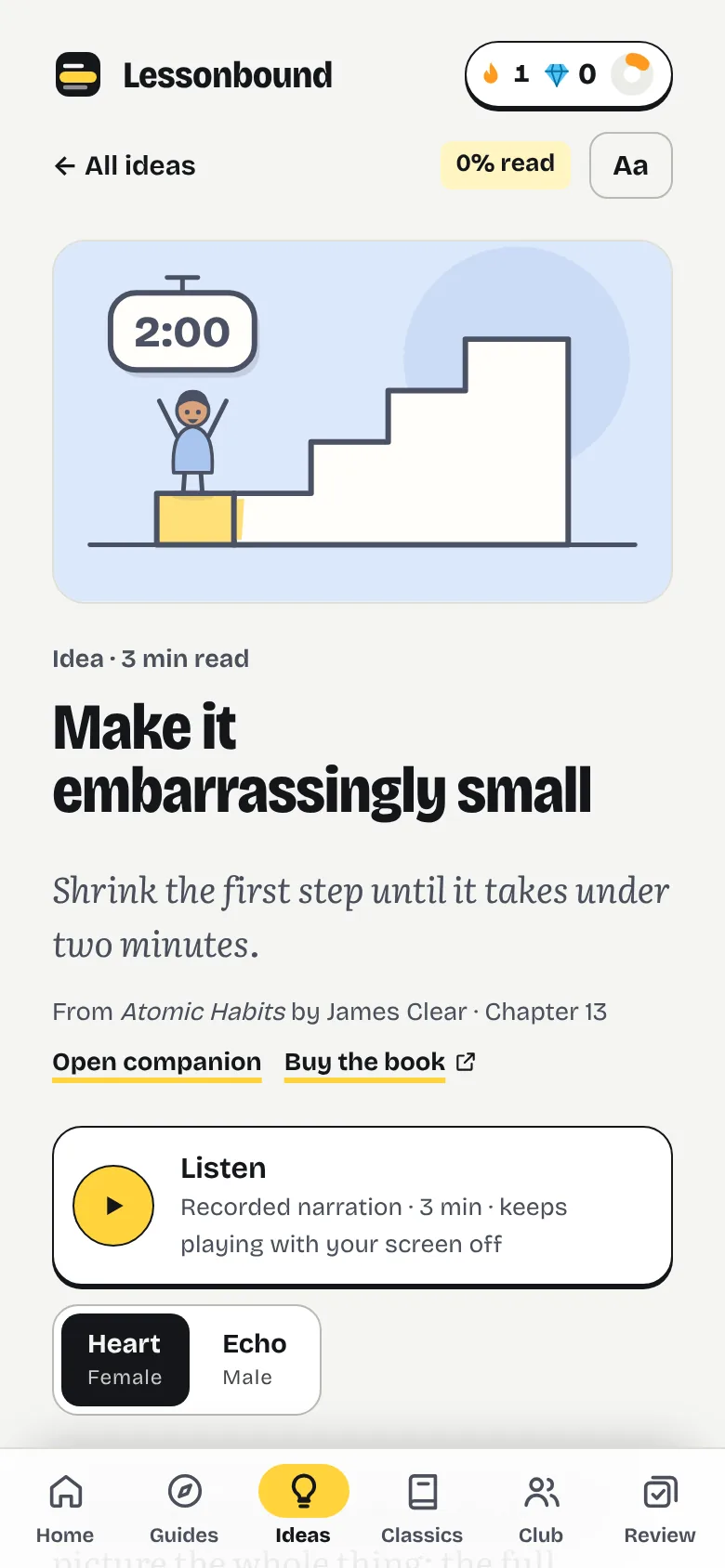
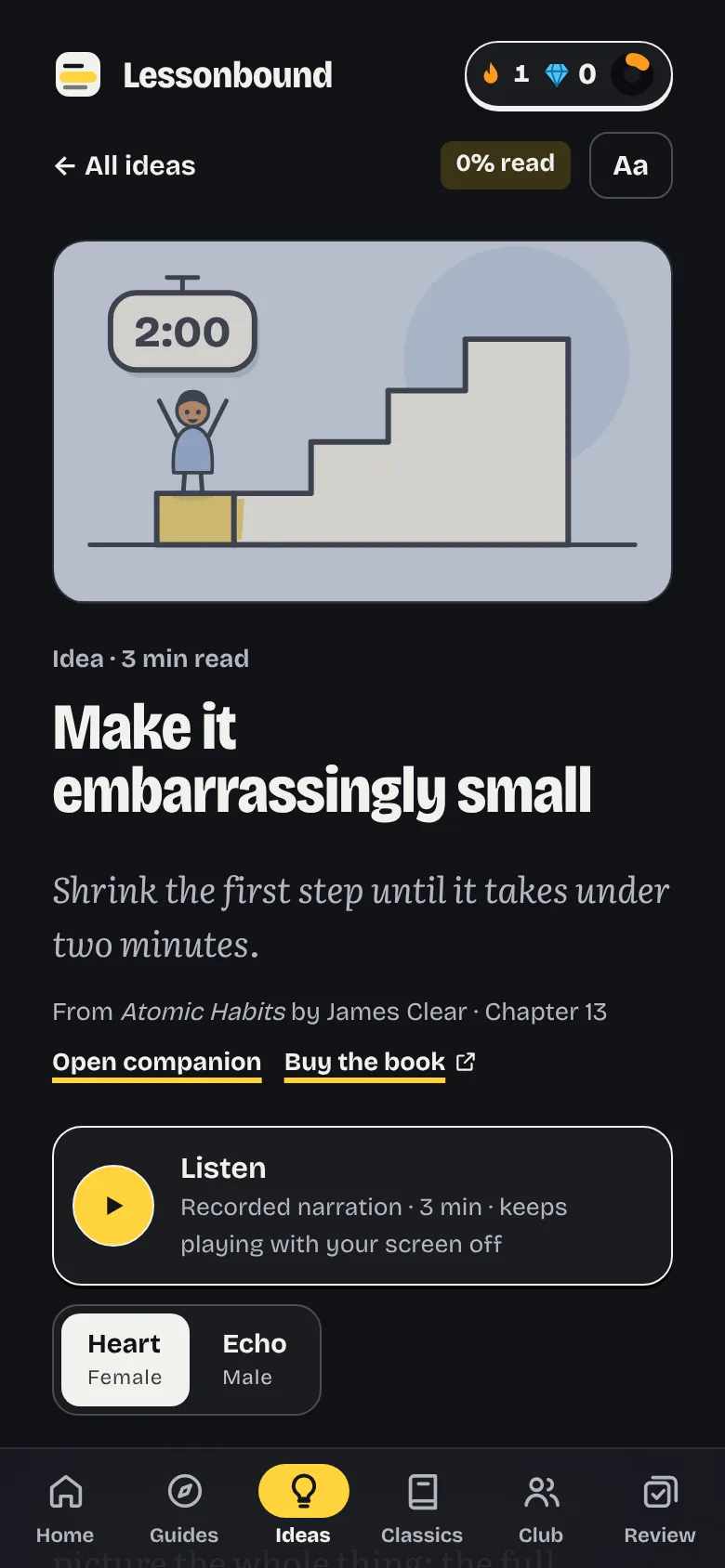
- Atomic HabitsMake it embarrassingly smallShrink the first step until it takes under two minutes.
- Atomic HabitsSet it up the night beforeMake the right action the easiest one in the room.
- The EnchiridionPick up the other handleEvery situation has a handle you can carry it by.
- Deep WorkEvery switch costs youPart of your attention stays behind every time you switch tasks.
- How to Win Friends and Influence PeopleGet curious before you get angryCriticism makes people defend. Understanding makes them change.
- The EnchiridionEverything has a priceIf you didn't pay for the lettuce, you don't get the lettuce.
Press play. The highlighter follows the narrator.
Every page in the app is recorded, sentence by sentence. Tap any line to jump there.
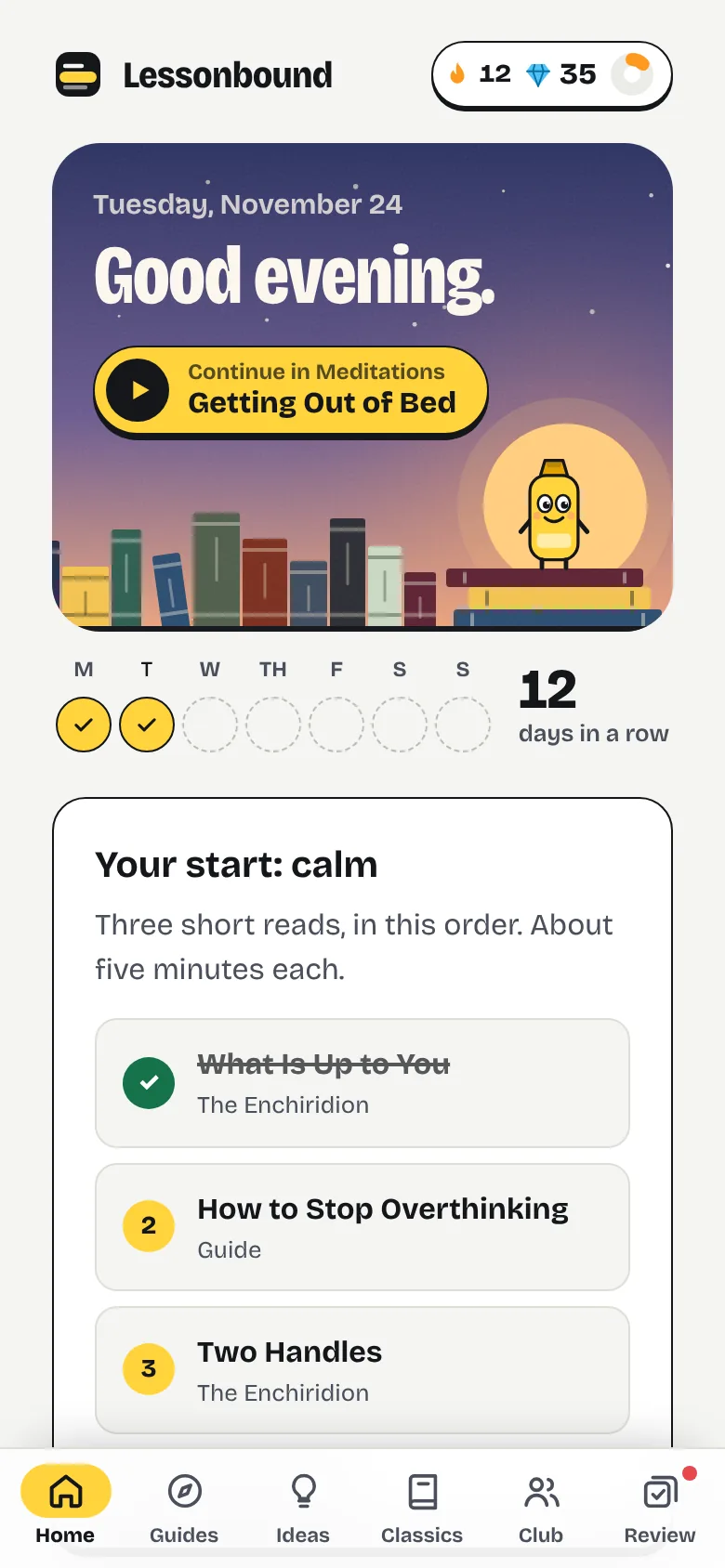
Getting Out of Bed
Book 5 begins with Marcus struggling to get up in the morning. His answer to himself: I'm rising to do the work of a human being. Why complain about doing what I was born for? Was I made to lie under the blankets and keep warm?
He points out that plants, birds, ants, spiders, and bees all do their part in the world without complaint. Rest is necessary, but nature put limits on it, and he admits he goes past those limits while falling short on his work.
Later in the book comes one of his best-known ideas. Other people can block his actions, but not his intentions or attitude, because the mind can adapt and turn any obstacle into something useful. What stands in the way becomes the way.
The theme is duty without drama. You don't need to feel like working. You need to remember what you're for, then do the next thing.
Marcus admits something many people never say out loud: he loved comfort and found it hard to leave. He asks whether he was born for pleasure, to be pampered, and answers that he was born for action. He points out that people who love their craft wear themselves out at it, skipping meals and sleep, while he gives less care to his own nature than a craftsman gives to his trade.
Later in Book 5, he adds a line that has become one of the most quoted in Stoic writing: the impediment to action advances action, and what stands in the way becomes the way. He means that obstacles can be turned into material for virtue. A difficult person becomes a chance to practice patience. A setback becomes a chance to practice resilience. The obstacle doesn't stop the work. It becomes the work.
What it means today
Marcus's morning argument is about identity more than willpower. He doesn't tell himself to try harder. He reminds himself what kind of being he is and what he's for. Research on habits points the same way: people who see an action as part of who they are, such as “I'm someone who trains,” tend to keep it up longer than people chasing a result.
Imagine your alarm at six. The warm blanket makes a strong case for ten more minutes, then twenty. Arguing with it rarely works. Asking a different question does: what would someone who takes their work seriously do right now? The answer is obvious, and the decision stops being about how you feel.
The trap is reading this as a rule that rest is weakness. Marcus says plainly that nature set limits on sleep, and he only faults himself for going past them. Getting enough sleep is part of doing your work well. The question is whether staying in bed is recovery or avoidance, and you usually know which one it is.
Key takeaways
Motivation follows remembering your purpose.
Rest has limits. Notice when comfort turns into avoidance.
Obstacles can become the material for action.
Try this today
Write one sentence about what your work is for. Read it tomorrow morning before you check your phone.
The classics, in plain English
8 public-domain classics and 69 chapters so far, with a new Walden chapter most days. Pull a book out.
Inside the app
Reading something once rarely makes it stick. Review brings it back.
The Review tab turns what you've read into flashcards: a chapter's three takeaways, an idea, even your own notes. Chapters come back 1, 3, 7, 21 and 60 days later. Each day, a Recall Sprint mixes five lines from every book. Try both.
- Motivation follows remembering your purpose.
- Rest has limits. Notice when comfort turns into avoidance.
- Obstacles can become the material for action.
Which book is this lesson from?
Every situation has a handle you can carry it by.
Start free. Go Premium for every guide and idea.
Free
- All Classics and Book Club
- One full guide, and the first part of every other guide
- Today's idea, in full
- Streaks, notes and progress
Premium yearly
- Every guide and every idea, in full
- Paths: multi-week programs
- Audio for everything
- Sync across your devices
- 7-day free trial
About $3.33 a month, billed yearly
Premium monthly
- Everything in Premium
- Billed every month
- Cancel anytime
- 7-day free trial
Prices are in US dollars. Sales tax or VAT is added at checkout where it applies. Premium renews automatically until you cancel. If you're not happy, ask for a refund within 30 days of any charge. See the Refund Policy.
Questions
Do I need an account?
No. You can read the free library without signing up, and your progress is saved on your device. You need an account for Premium and to sync across devices.
How does the free trial work?
Premium is free for the first 7 days. If you cancel before the trial ends, you aren't charged. If you don't, your plan starts and renews until you cancel.
Why not just read the whole book?
You should, when a book earns it. Lessonbound helps you find which ones do, gets you through the hard old language, and helps you remember the parts worth using. The full texts are free at Project Gutenberg.
Who handles payments?
Polar (polar.sh) is our Merchant of Record and authorized reseller. Polar processes your payment, charges any sales tax or VAT, and sends your receipt, so your card details never reach us. The charge on your statement comes from Polar.
How do I cancel or get a refund?
Cancel from your account settings or the Polar customer portal linked in your receipt. For a refund within 30 days of a charge, email us with the address you paid with. Details are in the Refund Policy.
Is this advice from a professional?
No. Lessonbound is general reading and learning material. It isn't medical, psychological, legal or financial advice.